
In the end, everyone is aware of this:
nobody keeps any of what he has,
and life is only a borrowing of bones.Pablo Neruda
The Beginning
Our lives are bent, twisted and folded into shape by what we make of it and what is given to us. Like an echo of the earth’s crust, we fold and crumple, fall into the cracks, and under pressure make mountains only to tumble over the edge and be caught in the deep, loving embrace of the valley.
There in the silent, sweet soil, a tiny seed of creation already whole and complete, bursting with source energy, creates universes within universes. You and me; me inside you, you inside me is the beginning of our story.
You, in your living and dying made and unmade me, composted me with all the good microbes to nourish a new life. Death has broken me down to the base elements of existence – earth, water, fire and air – and in the light of day I have been made good.
In these letters, written to you over the last three years on your birthday, I’m looking back on your life and mine as a sweet and discordant sound, a wave that rises up to the surface, crashes and falls away, returning to source. Here one moment and then merging with the vast ocean disappearing just for a moment before reforming and rising anew, never dying.
I remember back to the day you died, 10 November 2002. We are standing in Ruffey Creek park near home, Susie, Chris and I, beer in hand, your tree the mother tree at our back, toasting you whilst the evening sky bled, whorled and wrapped in on itself. I wanted to travel back in time so night wouldn’t claim me with dreams about you still being alive, knowing I would wake to the shocking dawn motherless.
What remains in the wildly unpredictable quantum of human experience is an aching end that has morphed into something pure, wise and beautiful in its alchemical transformation. From the your fiery womb, I was birthed with strength, courage, curiosity and tenacity to traverse the life, death, rebirth cycle. From this liminal, deeply alive, feminine space is where I write this love letter to you, filling the void you left behind.
Everything that was broken has
forgotten its brokenness. I live
now in a sky-house, through every
window the sun. Also your presence.
Our touching, our stories. Earthly
and holy both. How can this be, but
it is. Every day has something in
it whose name is forever.Mary Oliver
Jan 3 2023, Letter from Currumbin Valley
Earlier this year, my brother leaves a message on my mobile. The Sally Tree, our Mother Tree, had been felled by the council. We had talked about the ominous tag, earmarked by the council for a while and now we know why. An unassuming, smallish, solid and stoic pine tree is where you wanted your ashes scattered 21 years ago, a tree that raised us, holding our grief in your boughs, shards of bones that had rested in the roughened bark crevices. Now there is no trace of you but a stump, the rest unseen, coursing through roots, rock and soil. I am treeless as well as motherless.
Oddly, I feel empty of emotion. Is it a sign my mother wound is healing? The scar tissue no longer looks red, raised and angry. It has softened, been nourished with acceptance, forgiveness and gratitude and over time the edges have come closer together. I am 58 and my mother hunger -which food could never fill – still gnaws at my gut. Perhaps this “holy hunger” will remain unresolved.
As a little forming person, a hunger for validation – to be seen, heard, and delighted in for who I am – pushed me to extremes to externalise my life, striving to gain recognition outside the family. I rushed through the first 30 years with an undeveloped inner world, frantic to find validation. As Richard Rohr, Franciscan priest, writer and speaker on spirituality says of this unfulfilled hunger…”you don’t have time to read inner emotions. Your emotional life – there’s no subtlety to it, there’s no nuance, there’s no freedom, there’s no grace, there’s no time.”
He writes in relation to men but his words are equally applicable to all people. I was a deer caught in the headlights, frozen, anxious to please, ready to flee when I could, then running, running, running away from myself and towards a place to belong. It’s exhausting. He continues…. “suffering …becomes the only path because it is the only thing strong enough to lead you into the world of grief…and those tend to be the holes in the soul that awaken the inner world.”
Grief and the work to feel it in my body does eventually wake me; it is the recognition that like all humans I am flawed and imperfect but I can still strive to deeply love and accept myself and hold myself in high regard. Over the three years I’ve been writing this letter to you, my rich inner world has come alive.
I wanted to be like you, pushed myself to be like you (worthiness). I couldn’t save you (shame); I wanted to save you from cancer (failure) ; I needed to save you as my mother (responsible), a grandmother (responsible to my children). My role I assumed in my family of origin was to make others happy, to be of service. I’d built my life in reference to and as a resource for the needs of others. And I felt I had completely failed at that. I felt a fraud.
To let myself off the hook, that I was not responsible for others’ pain and suffering is a big identity shift. Who am I when I am not that. How do I love? What do I love? How do I live? The landscape of grief and loss in these letters is intertwined with a certain kind of love.
Growing up, love felt ambivalent, unpredictable, full of contradictory thoughts and feelings. Excitement and fear, comfort and confusion, safety and absence. Love and a myriad of other feelings were unexpressed, hidden from view but omnipresent somehow. On some days love seemed to come with crushing burden, unmet needs, entrapment, obligation and emotional suffocation. Ambivalence primed my nervous system for anxious attachment early on.
This undulation of love (and grief) is what Esther Perel, psychotherapist calls, “relational ambivalence” and what I have come to understand is not just my pattern. She writes that we experience it with our parents, our siblings, our friends and in our romantic relationships. “We feel the tug between the parts of us that are forever entwined with them and the parts of us that want to separate ourselves.” It is strangely comforting, true and real for me to think that the unconditional love I am striving for with others is a fraught concept.
Changing my reference point to my inner landscape is painful, tangled, and solo work, where pulling a loose thread just tightens the ball of wool until I throw it into the corner in disgust. In moments of stillness, I see the coloured threads of my inner ecology, the core wounding of separation – abandonment and rejection, shame and failure – unravel and the knotted ball I’ve been fighting loosens.
My body remembers to breathe, digest, and rest. Intellectually I know these wounds are the cause of my grief but it is the first time I allow myself to feel them in my body. As the mauve flowers on the Jacaranda tree, the other self appointed Sally Tree, come into full bloom, the final pieces of the mother story, reflected in the ending of my current relationship, come together and finally make sense. All the disparate elements of my biography, all the things I have ever known or loved, all the things that I am, are stiching themselves back together into wholeness.
Why am I writing this at the beginning of the ending? It sharpens me, hones me, bends and breaks me and puts me back together, helps me make sense of what I have written to you over the years; where I came from and where I am going. Time is a mother and in this decade, these last 3 years, this year, right now, I learn more about life and love from you than at any other time.
Jan 3 2022, Letter from Currumbin Valley
Your Parker writing bureau stands in the bedroom empty, after its journey from a Melbourne storage shed where it has sat since we sold the family home in 2018. No aerogrammes from Gran in the letter slots. No pens or ink pot, or packs of photos from your last trip to the UK. No manilla folders with news clippings, financial reports, or old essays in the drawers. No cupboards filled with wrapping paper or sewing paraphernalia. The desk is bereft of your industry and ambition, your drive and determination. I unlock it and gently lower the writing table; the woody interior releases its distinctive smell of longing.
Today is your birthday and the 20th year anniversary of your death. As I’ve done for many years on this day I write a love letter to you. But this time I do it at your desk, filled with nostalgia and ambivalence, and a creeping dread that threatens to overtake me and sell this singularly beautiful thing. Could I sit with the difficult love I feel for it, for you, make your desk my own even as it screams of your piercing, concise intellect so different from my own dreamy self? The desk that transported you to England and away from me with every letter you wrote home, your inner world entirely inaccessible to me. I loathe this desk and love it.
A week later with the encouragement of my family, the desk is now a museum of curated objects: a sherry glass and bottle of Spanish sherry, your grandmother’s mirror, T.S. Eliot’s Four Quartets, the Tao Te Ching and Thich Nhat Hanh’s Present Moment Wonderful Moment. I couldn’t resist adding Moldy Warp the Mole to the collection of books reminding me that once you were a child with a curious enquiring mind too. There’s your antique perfume bottles and a tiny cushion you made with the same material as my curtains that still smells of you and lavender.
My diaries from age 27 when I left Australia and felt free for the first time rest easily amongst your objects, reminding me I have made peace with and finally claimed your desk as my own. The soft fronds of the maidenhair fern sits on the top of the desk – your favourite indoor plant – tells me this desk is a place of history, beauty, of quiet contemplation. My body eases into the chair and I feel the sense of dread lifting. I understand why you left my sister and I in that bleak Melbourne winter of 1967 for the UK, leaving us with an oversized surrogate mother rag doll for comfort. Made from our hideous lounge room curtain material because my gentle grandmother, Lyla, could find no other way to lessen our sense of abandonment and grief. We hid her monstrosity in a cupboard, so we didn’t have to be reminded of your absence.
You did come back eventually but the trauma scars from your leaving are still in my heart. Now there’s a wider, more compassionate space for them to exist. I am of you but not like you. I’m painfully aware of the mirror that reflects back to me all the ways I tried to love you, tried to be more like you at your desk; pushing myself, striving for perfection to the point of depletion and exhaustion. I thought in my childish way that this was love, thought love was conditional and transactional as a way of securing your approval so you’d find reasons in me to stay.
Now in my second Saturn return at age 57, I can see these projections, make peace with and take responsibility for them. I understand why you left and know now the necessity of freedom too. Despite that, your desk will always hold the mother lode: anger, betrayal, humiliation, despair, distrust.
Jan 3 2019, Letter from Melbourne
Mum, it would have been your 80th Birthday. Today I visited the Sally Tree and there you were. White filaments of bone, fragments of the solidity of you caught in your deeply veined bark. We’ve added to you, some from Susanna, more of you over the years and I could see etched in the ground our pilgrimages to your tree with its beautiful outlook on Ruffey Creek Park. All our tangled DNA weaving its way through soil, roots and bark leaving traces of where you have been and where we have stood over the years.
Jan 3 2021 Letter from Mon Repo, Bundaberg
We visited your tree again in 2020 this time with Dad’s weighty ashes. Bro and I scattered some there after his death on June 2nd 2020. Both our arms encircled your tree, his above mine. A tree that held you up in your aliveness, in your dying and now has the remnants of what you made of all us, 18 years after your death. The tree that held all of us up, brought all of us together, the truly great wild mother to us all.
I understood very little of you, but understood why you loved this tree because its trunk fitted you, a comfort. It felt safe, reassuring, dependable ever present tree labeled by the council tree register no 188. And it’s the first time that I felt myself saying thank you and feeling deep gratitude for you. Thank you for the sacrifices you made for us. Thank you for pushing yourself to show what a woman could do – return to high school, matriculate, university with honors, postgraduate study, groundbreaking work in a women’s financial investment network – with a deeply inspired intellectual, social and emotional life.
Thank you for sharing your love of beauty, books, film and art, your enquiring mind, your love of food and landscape. Thank you for protecting me in those childhood moments when I didn’t know what to do. Thank you for the small caring gestures: keeping the lights on, the notes left for me when I came home late, the articles you cut out of the paper and sent to me. Your care, concern and love for me was palpable in those times, but most of all, I miss never having truthful conversations that could have brought us closer together when you were alive.
I felt how private you kept your illness, shielded others from knowing your pain and suffering and why you wanted to keep it so. You didn’t want pity or sympathy or someone’s judgment or cancer fix. You just wanted more of life, to feel that intensity move through your body. I had no solutions for you, couldn’t help you, didn’t know how to. No maps, sign posts, markers except this tree to navigate the territory and the terror of being alone again in a motherless landscape.
Back at home, I’m looking out to the jacaranda tree, leafy and gracious in its proportions. It’s probably half your age, I’m guessing 40 years old with inviting low branches that I’ve hung over and climbed up. In November the mauve flowers bloom, the air is humming with bees attracted by the subtle nectar and essence of purple and there’s a carpet underfoot fit for a queen. When we first moved to Currumbin Valley, this tree became you. I look out from my office and there you are in your blooming radiance; your spirit in that tree will outlive us all.
Jan 3 2022, Letter from Currumbin Valley
Today I’ve put an old teak rattan backed chair under your longest lowest bough and sat there reading your story aloud drinking a toast to you with cyclone Seth off the coast raising his voice in accompaniment, the sky turning a startling, iridescent streaked orange.
Jan 3 2021, Letter from Mon Repo, Bundaberg
The first week of November 2002 in the Freemasons hospital was a surreal nightmare. Our little family was jet lagged from a 14 hour flight, summoned by Susanna who had a more finely tuned sense of your imminent death. Cass was 18 months – perhaps too young to remember – and Bella 4 years old, bewildered by all these adults, bewildered and grief stricken themselves.
I remember you and I sitting on old school chairs on the hospital balcony just before you died and you saying to me how you hoped you had been a good mother. How could I answer that in the last moments of your life? Somehow most mothers unconsciously scar their children, implanting their own wounds into their offspring. A young mum myself with only an inkling of the depth of guilt mothering engenders, I think you were frightened by what I would have said if I shared my true feelings. A conversation amongst many we never had because we didn’t do truth telling. You gave me everything but nothing. The weight of both hanging in the air between us.
How could you know I needed more space, than the narrow hallway that ran through the middle of our small brick home, an in between airless space I occupied: middle of my sister and brother, my mother and father, so many divided loyalties to serve, please and keep the peace. I had no voice, no air left in me to say out loud, “Stop, this is not me.” I wanted another door to enter and find you or someone like you who could listen to me, and say, “I hear you, I see you, I love you. You can put down your burden now.” How could you know I needed a voice when you were just learning to hear yours?
I’ve had to traverse so much territory on my own as a kid and then as a young woman. But that seemed to be the parenting style back then, left to my own devices to figure out how to initiate myself into becoming a woman, how to hold my ground and stand on my own two feet. Now, on what would have been your 82nd birthday, 3 Jan 2021, I feel in my bones an inkling of what it meant to be a young mother, young wife, a shy immigrant in a foreign country; displaced and yearning for England, no friends or family, essentially alone…oh the despair, desolation and desperation.
Born at the outbreak of war on January 3, 1939, fatherless at a young age, Harold could have been your early chance of being deeply seen, heard and understood. A memory you told me of always hiding behind a chair when the doorbell rang, belies the trauma of the day you heard Harold had died in the D Day landings of June 1944. You were 5 years old.
Gran, your mother Margaret might have seen you as precocious liability, sent you to an austere Quaker boarding school where cold showers and hot potatoes hidden in pockets as hand warmers were the only things I remember you telling me of those early days. These are only my interpretations, how could I know, just imagine.
I remember the radiant look on your face when you stepped off the plane to embrace the English winter of 1980. I was 16 on our first trip overseas with Susanna, just the three of us, watching you mesmerised by the light, the soft northern hemisphere glow so unlike the harsh Australian sun. Hearing you laugh with all your friends in Huddersfield get togethers, watch you get drunk and dance as though this was home.
But you left it because you needed something else. What was that? Intellectual adventure, real life adventure? I’m imagining that’s what Dad presented on an open face of a tennis racquet when he gazed at you across the court in Huddersfield.
Sally Crosland, it sounds like such a contemporary name! English of course and that’s how I remember you. Your Englishness and sharp, opinionated mind seemed to hold you apart from me without really meaning too. And you were a contemporary woman. The first wave of feminism was deeply embedded in your psyche, perhaps a combination of your generation and missed opportunities, and just in your early 20s. And oh so bright, analytical, a deep and passionate thinker.
An aesthetic that appreciated the beautiful, mixed with your determination, infused everything you did whether it was tracking down the best coffee, mille feuille, scallops, stilton tart in Melbourne or an obscure new release movie. In your last week in hospital, I brought these delicacies to your bedside as a reminder of our romps around town and our shared passion for good food. I remember them as a heady mix of joy, pleasure, adrenaline, and dopamine with the inevitable crash afterwards. You devoured life abundantly with a full and fierce intensity.
I remember the first time you held Bella when she was 2 weeks old. And saw me mothering for the first time, in deep admiration and appreciation, almost surprised. It is the singular memory I have of your validation. Maybe it stirred something in you as a young isolated mother; ambivalence, old memories of exhaustion, homesickness or was it fear of not knowing how to cope as a 25 year old with me as a newborn, Susanna only 18 months old and no extended family support?
When Dad randomly tells me that, as an infant, I was taken to the best pediatrician in Melbourne and received a diagnosis of “failure to thrive” everything falls into place. In the 1940’s American analyst Rene Spritz coined this term for children separated from their parents and caught in inconsolable grief. Knowing more about attachment theory now, I could give myself a more accurate diagnosis, mother hunger. A kind of unrequited love and desperation for maternal bonding, comfort and nourishment that informs all my future relationships. Perhaps my wise and knowing infant Piscean self was caught in the struggle to stay or go; 2 fish joined by a silver thread, one desperately wanting to return to the spirit world and the other choosing to incarnate into this life knowing already of the struggle and suffering ahead.
I’ve had to make up my own stories from things I’ve intuitively felt, remembered or heard over the years from other family members. But isn’t this what our memories are made up of, a heady mixture of nostalgia and longing, that change as we change that morph and mutate, are embellished upon and flourish just as we do? That are as different from each sibling’s rememberings as we are from each other.
Jan 3 2023, Letter from Currumbin Valley
Now when I visualise opening one of the doors off the hallway in 2 Ibis St Doncaster, the family home, I don’t find you anymore. I see myself and parts of you are in me. The mood in the room is gentle and receptive, loving, kind and wise. I must look to the young person opening the door to have aged more than my years suggest and somehow that soothes her. This feels like home, a safe resting place to stop, be still and drop her burden at last. There is love here and there has always been, I was, you were, just too busy being deep in the story to see it.
Growing up requires us to differentiate, separate and individuate from our parents. It is healing to restory ourselves with a new and powerful narrative that is as vast and oceanic as we are. I could clearly see that early childhood trauma and witnessing yours and Susanna’s dying shut me down to feeling grief and loss, made me run from the fear of dying of cancer, though there was clearly nowhere to go but to face the fact of my own eventual death.
Instead of running away, life teaches us that loving is a daily task and living is right here right now. The spiritual work is to stay present to the whole fugazi, the monstrous messiness, the entanglements and difficulties of family life and the unsung service and enormous labour of motherhood. In an undivided life we allow everything to flow in and out of us; the pain, distress, joy, ecstasy, awe and heartache. Inside us are vast, mysterious universes roiling, boiling, churning and turning, kept in place by a thin skin, in a fragile human body loosely tethered to Earth.
When I die, my daughters will have their own ways of remembering me, perhaps the unspoken ways in which we broke each other open, and maybe even their own Mother Tree where my body’s borrowed bones will be returned to where they came from.
Motherhood is the place in our culture where we lodge – or rather bury – the reality of our own conflicts, of psychic life, and what it means to be fully human. Mothers are the ultimate scapegoat for our personal and political failings, for everything that is wrong with the world, which becomes their task (unrealizable, of course) to repair.
Jacqueline Rose, Mothers: An Essay on Love and Cruelty
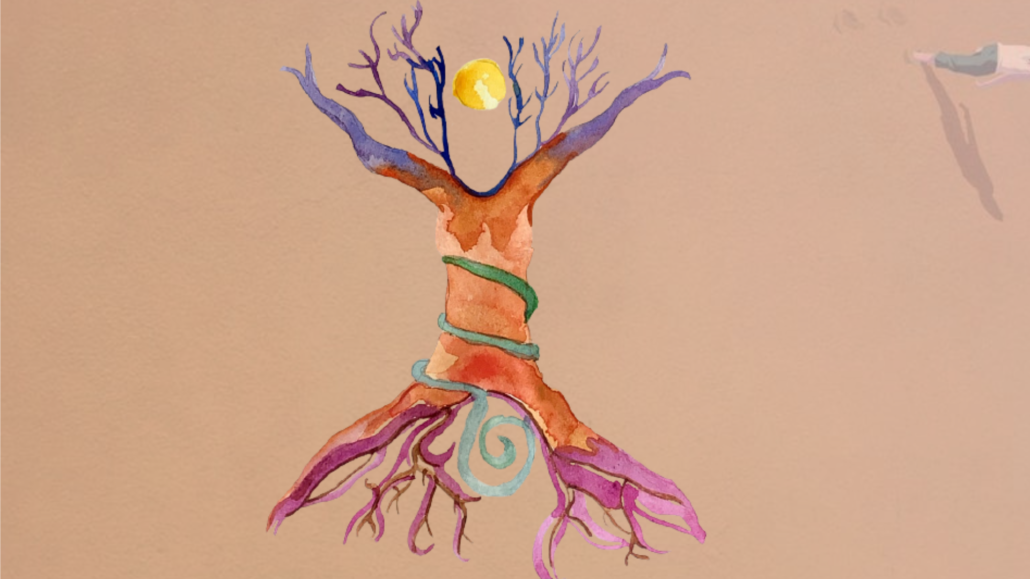
Image credit: Original art by Cassia Carnell Serpent Tree Woman © 2023
